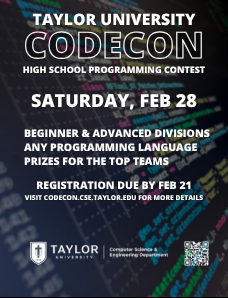
**CodeCon: S2026 HS**
!!! Important Canceled!
This competition has been canceled.
We are planning to host this again next year.
If you would like to be added to the email list, please send a note to [codecon email](mailto:codecon@cse.taylor.edu).
The first annual Taylor University High School Programming Contest (CodeCon: HS), sponsored by the Computer Science and Engineering department and Admissions, will be held 2026 February 28.
This contest is open to all high school students, including public, private, home-school, or co-op schools.
Each team consists of up to three students with a single laptop.
Teams must have a school sponsor (can be parent with home-school).
There are two divisions: Beginner and Advanced.
All members of a Beginner Division team should have no more than one semester of programming instruction and no more than one year of programming experience.
Advanced Division teams have no restrictions on education or experience, so any high school student may compete.
The primary difference between the two divisions is the problem complexity.
This competition is limited to the first 90 registered students.
Each school may register up to four teams.
Additional teams and students will be placed on a waiting list.
Registration is now closed.
Send questions to [codecon email](mailto:codecon@cse.taylor.edu).
# Rules
Below are the general rules for the competition.
## School, Sponsor, Team
- Each high school must have a school sponsor who will register the team(s), be the primary contact person, and be present and responsible for the team(s) at the competition.
- Each school may register up to four teams in total (regardless of division). Additional teams for a single school can go on a wait list.
- Each team can have a max of three members.
- Each team will need to bring their own laptop that they will use during the competion.
## Laptop, Languages, Software
- Each team must bring their own laptop with software already loaded.
- Only one laptop is allowed per team. No external keyboards or monitors are allowed, but an external mouse is acceptable.
- Any programming language may be used to solve the problem.
- Internet access and phone usage will not be allowed.
- Each team may bring a single printed reference book.
- No printers are allowed in the contest area.
- No audible audio will be allowed.
## Problems and Solutions
- Problems will be distributed to each team in printed form. These sheets will include:
- Problem description
- Definition of input format
- Definition of output format
- At least one example input with corresponding correct output
- Take a look at [Aldur](example-problem.html) to see an example.
- Solutions to the problems will involve topics typical of a basic computer programming course, including AP Computer Science. For example, problems may require numerical calculations, string manipulations, logical decisions, 1- or 2-dimensional array manipulations, etc.
- The primary difference between the Beginner and Advanced divisions will be in the problem complexity.
- All solutions must be written from scratch. No pre-existing code may be used, as with code samples, help files, tutorial snippets, etc.
- Teams may not change source code while judging.
- For example, commenting / uncommenting code will not be allowed
- This means that inputs should not be hardcoded. Instead, the program should take input while running (from stdin). See section below for examples.
- Some extraneous but fixed output (for example, printing description of input before reading input) will be ignored by judge as long as the output is clear and obvious.
- Programs should not print debugging information during judging time, as this might be considered as incorrect output.
## Judging and Scoring
- Solutions will be judged by output values and not by style.
- Only correct solutions will receive points.
- All decisions of the contest officials are final.
- No additional time will be given due to equipment failure, power outage, etc.
- Teams will have two attempts to get a correct solution for each problem.
- When a team is ready for their solution to be tested:
1. One team member will check in with the judge table.
2. A judge will follow the member back to their team.
3. The judge will provide a set of inputs, one at a time, and inspect the program's output.
- The input will be provided to team in similar format to problem sheet.
- The team is expected to enter the input into their program.
- The judge will verify that the input is entered correctly.
- If the input is mistyped, the team may rerun their program to retype the input again.
- Program output is expected to match output format definition.
4. Testing ends when a solution is judged as incorrect or if all tests pass.
5. The judge will inform the team whether they have a correct or incorrect solution.
- Some problems may have more than one test cases. A solution is considered correct only if all of the test inputs had correct solutions.
- Any crash, whether due to a bug in the team's code or a crash in the development environment, will be considered as an incorrect solution.
- None of the problems involve considerable computation. Any solution that takes longer than 5 seconds to finish will be considered incorrect.
- Teams have two attempts to submit their solution.
- If the first submission solution is correct, the team will earn 20 points plus one point for each whole minute left in the round (floored).
- If the second submission is correct, the team will earn 10 points plus one point for each whole minute left in the round (floored).
!!! Important Important!
The program should produce outputs that are clear to interpret.
The judge will interpret the output without help from the team.
## Contest
- The contest will consist of five rounds.
- For each of the first four rounds, teams will have 20 minutes to solve one problem per round.
- For round five, teams will have 40 minutes to solve two problems.
- Sponsors will remain in the common space and may not communicate with the teams during the rounds.
# Example Program Input and Output
Here are three examples of reading input from stdin and printing to stdout in different programming languages.
Teams are not required to use any particular approach to I/O.
For example, instead of using `cin` and `cout` in C++, they can choose to use `scanf` and `printf`.
Python
```
n = int(input("Enter the number of test cases: "))
print('Test cases %d' % n) # uses % formatting
print(f'Test cases {n}') # uses f-string
```
Java
```
import java.util.Scanner;
import java.io.Console;
public class Test {
public static void main(String[] args) {
int n;
// using Scanner and System.out.print
Scanner scanner = new Scanner(System.in);
System.out.print("Enter the number of test cases: ");
n = scanner.nextInt();
System.out.println("Test cases " + n);
// using Console.readLine and Console.printf
Console console = System.console();
console.printf("Enter the number of test cases: ");
n = Integer.parseInt(console.readLine());
console.printf("Test cases %d\n", n);
}
}
```
C++
```
#include <iostream>
int main() {
int n;
// using cin and cout
std::cout << "Enter the number of test cases: ";
std::cin >> n;
std::cout << "Test cases " << n << std::endl;
// using scanf and printf
printf("Enter the number of test cases: ");
scanf("%d", &n);
printf("Test cases %d\n", n);
return 0;
}
```
# Timeline
The following are dates and times to keep in mind.
## Registration
!!! Important Canceled!
This competition has been canceled.
We are planning to host this again next year.
If you would like to be added to the email list, please send a note to [codecon email](mailto:codecon@cse.taylor.edu).
Registration is opens from January 12 until February 21 or until 90 students are registered, whichever comes first.
Each school may register up to four teams.
Additional teams will be place on a waiting list.
## Competition Day
This event will take place in the Euler Science Complex ([Google Maps](https://www.google.com/maps/place/Euler+Science+Complex/@40.4561941,-85.4966986,17z/data=!3m1!4b1!4m5!3m4!1s0x8815042349b345d9:0x4a6991bca902dde9!8m2!3d40.4561979!4d-85.495062)).
Parking is available in the Nussbaum parking lot ([Google Maps](https://www.google.com/maps/place/Nussbaum+Parking+Lot,+Upland,+IN+46989/@40.4551202,-85.4950052,19.24z/data=!4m5!3m4!1s0x8815043ca5404147:0xcec2bf6b23be1113!8m2!3d40.4548735!4d-85.4947498)).
The following is the schedule for Saturday, 2026 February 28.
| | | | |
| ----: | ----: | :-------------- | :----------- |
| 8:00 | 8:45 | Check In | Euler Atrium |
| 9:00 | 9:30 | Round 1 | Nussbaum 102 |
| 9:45 | 10:15 | Round 2 | Nussbaum 102 |
| 10:30 | 11:00 | Round 3 | Nussbaum 102 |
| 11:15 | 12:45 | Lunch + Tours | Hodson Dining Commons
Euler Science Complex |
| 1:00 | 1:30 | Round 4 | Nussbaum 102 |
| 1:45 | 2:30 | Round 5 | Nussbaum 102 |
| 2:35 | 2:50 | Awards Ceremony | Nussbaum 102 |
Lunch will be provided by Taylor Admissions.
Awards will be presented immediately following round five.
After the awards, each team will have time to pack up their stuff
# Awards
Awards for top placing teams will be announced soon.
# Advertisement